
19th-century Guitar Specialist – JamieAkers.com
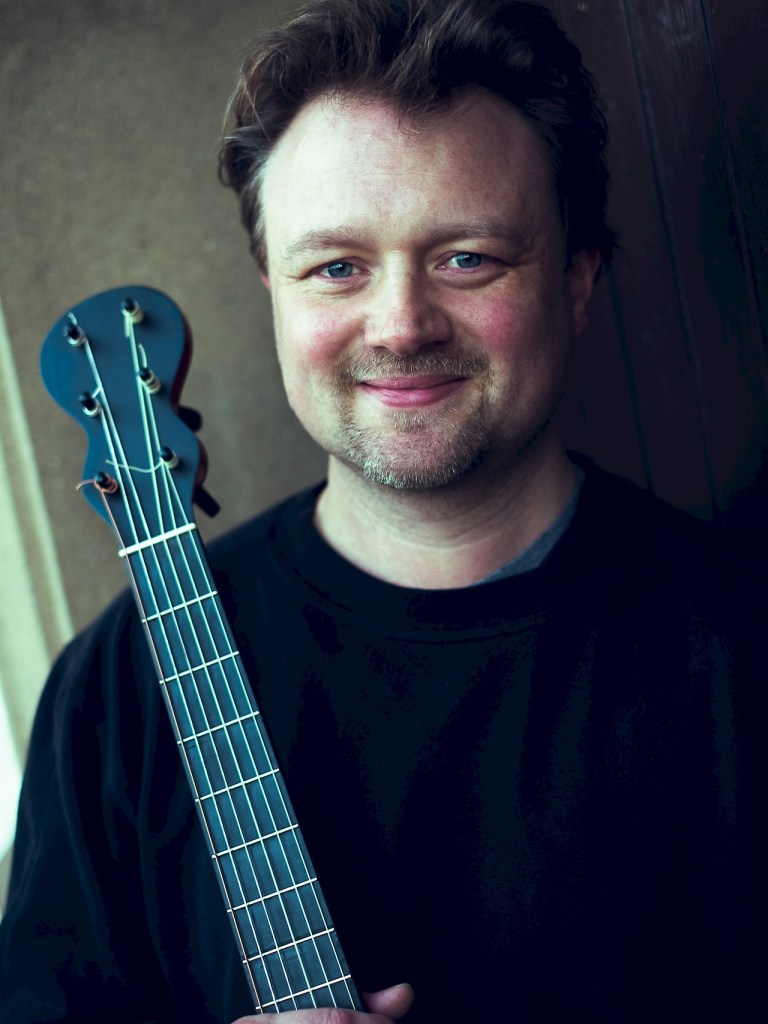
It is particularly pleasing for me to interview someone I had a very small part in helping a hundred years ago, or so it seems, when he enrolled at Napier College in Edinburgh where I was a Lecturer in Guitar. He appeared at a time when I had shifted from classical guitar performance to lute, and it wasn’t long before he also changed his 1st-Study Instrument from guitar to lute. He then went on to study with one of the world’s great lute players, Jacob Lindberg, at the Royal College of Music in London, leading to duo recitals with the prima Early Music vocalist, Emma Kirby, all the while embedding himself in the London Early Music scene. Numerous recordings followed with a variety of ensembles as lute and theorbo specialist, before his return to the guitar, in particular the 19th-century variety. But I was surprised when Stefan Wester suggested I interview Jamie Akers for this website, as I was unaware of Jamie’s interest in the Russian-Ukrainian 7-string guitar…
Rob MacKillop: So, Jamie, first of all: why the 19th-century guitar? Let us know about your 6-string activity before we move on to the 7-string.
Jamie Akers: There are a few reasons I turned to playing 19th century guitar. After many years playing the lute and related instruments, I felt like a new challenge and began exploring the history, repertoire and techniques of the 19th century guitar. A few things immediately struck me. Firstly, there was a vast amount of music that no-one had explored, secondly, that the traditional historical narrative of the guitar as being pre-dominantly Spanish is factually untenable; thirdly the technical approaches of 19th century guitarists haven’t been explored fully and, finally, that the interpretation of 19th century guitar music has been distorted by an absence of meaningful contextualisation.
I began putting together programmes of music in which, I thought I could bring something worthwhile to the interpretation of neglected or under appreciated works. Initially, this was Italian composers, like Giuliani and Legnani. Having performed in dozens of operas, I found in their music the vocal and lyrical qualities of Italian opera transposed to the mini-sound-world of the guitar. To me, this quality in their music has often been neglected by performers, who approach it as if it’s primarily “guitar” music and don’t allow the vocal character of the melodies to “sing.” I believe that this has resulted in an unjust denigration of these composers whose music is more substantial than it has traditionally been considered. I was also struck by the amount of music I found by women composers, much of it of very high quality and was encouraged to explore this as part of the “Donne Foundation” series of recordings. These two projects were well received and widely reviewed which encouraged and enabled me to continue with the 19th century guitar.
Another aspect of the 19th century guitar that I perceived to have been neglected is the music for extended range instruments, those with extra bass strings and often high frets as well. I began investigating this repertoire and quickly found a wealth of music by some truly excellent composers, again languishing unjustly unexplored. Most of the music I found came from Eastern Europe and of these composers, the most capable and consistently inventive I found was the Ukrainian born Russian guitarist Ivan Klinger. Klinger largely wrote for 8 string guitar and produced works that rival any by the better known composers of his era.
RM: The Klinger album is fascinating, highly recommended, as discussed by yourself and Oleg Timofeyev in this entertaining and informative video:
JA: While Klinger’s music is readily available, information about his life and milieu is difficult to access, especially to non-Russian speakers like myself. I was very lucky to be able to consult with Oleg Timofeyev, who found out a wealth of information about Klinger. I wanted to make this information as accessible and widely available as possible, to help promote Klinger’s music and engage with its potential audience, so I had the idea to make a mini-documentary about Klinger’s life and music. It took a little longer than I’d hoped to make Klinger: The Movie, so it wasn’t ready for when the album was released but the album had some success on streaming platforms -having been streamed over 800,000 times on AppleMusic – so I persevered. Hopefully, it will now function as a resource for anyone who might like to learn more about him. I also hope it will encourage other guitarists to explore and perform his music.

RM: Jamie’s latest release, Fantasie Romantique, has music by Pietro Pettoletti (c. 1795-c. 1870) on a six-string guitar; by Johann Dubez (1828-1891), Nicolai Petrovich Makaroff (1810-1890), and Johann Kaspar Mertz (1806-1856) on an eight-string guitar; and by Mikhail Polupayenko (1848-1902), Johann Decker-Schenk (1826-1899), and Nicolas Pavilstscheff (1802-1879) on a nine-string guitar. All with the first 6 strings tuned EADGBE:

RM: So, when did your compass point towards the 7-string in G tuning?
JA: Having explored a lot of Eastern-European 6-string repertoire, it seemed like a logical next step to investigate the 7-string music. Mårten Falk kindly put me in touch with a student of his who had a guitar for sale and I took it from there. Initially, my explorations were a little haphazard. I didn’t find adapting to the tuning too difficult but the vast amount of music available meant I didn’t know where to start and kept jumping between pieces. Eventually Oleg saved me once again by asking if I would play a Sychra programme at IARGUS 2023, to commemorate the 250th anniversary of Sychra’s birth. This gave me both direction and impetus and I began to seriously study Sychra’s music and practise 7-string guitar in preparation for the IARGUS festival.
RM: I would love to attend that festival, but alas that cannot happen due to my fear of flying. Nevertheless, I hope Oleg and his team manage to keep it going for years to come. Can you go into some detail regarding your time there?
JA: IARGUS 2023 was a lot of fun. The festival was quite small that year, which worked out well for me as I was definitely the least experienced 7-string player there. The opportunity to hear other players, try out different instruments and have access to Oleg’s breadth of knowledge was extremely valuable. I performed my Sychra programme, the first time I’d played 7-string in public – and it was on a borrowed guitar – and took part in some quartet and other ensemble performances. There were 4 concerts, which all participants performed in, plus workshops and beer tasting. It was an ideal way to immerse myself in the instrument and the music in sympathetic, encouraging and friendly company.
RM: I imagine you will have a recording project in the pipeline. If so, could you give us an insight into what that might be?
JA: I’ve always got a few irons in the fire but one thing we discussed while I was in Iowa was expanding my Sychra tribute programme into an album devoted to his music. I try to record albums that function as “musical journeys,” that can be listened to in their entirety and that have an “emotional narrative,” so I’m working on putting together a collection of Sychra’s works that carries the listener along in this way, while allowing the inventiveness and musicality of his compositions to shine through.
RM: Are you a fluent reader yet with Sychra’s ‘fractional’ fingering? I am trying to improve my skills in that area, but confess to sometimes writing a score out in lute or guitar tab!
JA: I can sight-read the notes pretty fluently in G major tuning. Regarding Sychra’s fingering system, it depends, sometimes it’s pretty obvious what he means and, having played a lot of baroque guitar, lute and theorbo, the campanella fingerings are usually clear to me. I’m too lazy to write stuff out in tab so just persevere with the standard notation. The thing I struggle with most is the use of the left hand thumb over the neck. I can’t reach beyond the 7th string so often have to change Sychra’s fingering at those moments. Some of Sychra’s fingerings are essential to convey his musical ideas while others are more a matter of preference, it seems to me, so I confess to changing things occasionally while trying to maintain the melodic shapes and harmonic functions.
RM: What is your impression of Sychra the composer and arranger?
JA: The more I play Sychra’s music, the more I find things to admire in it. I think he was a very capable all-round musician who applied his skills diligently and expertly to the guitar. His scores are often incredibly detailed, more so than any other guitarist of his time, with masses of fingerings, dynamics and tempo indications that show a very refined aesthetic sensibility. He wrote some truly inspired works but like many composers of solo instrumental music of his time, is often limited in his approach to form. The huge number of Fantasias or Themes and Variations he wrote, do make it difficult to put together a sufficiently varied programme of his music. Much of his music is written for didactic purposes which can limit the range of possibilities within particular works. He is a gifted and inventive arranger who manages to adapt music to the 7-string guitar in ways that make it playable without losing the character of the original work. Overall, I see him as being very much within the tradition of professional guitarists of the 19th century, like Giuliani, Carulli etc. He was someone who had to diversify his talents, in order to make a living. This results in a broad range of output, some of it extremely advanced and developed, such as the 4 Exercises, some less so, but there is always a craftsmanship and professionalism to his work that makes even the simplest piece worth exploring.
RM: Are there connections between the 6 and 7-string guitar worlds, or do you see them as being distinct from each other?
JA: I think the two overlap consistently and I prefer not to see them as completely distinct worlds. The classical guitar business has been limited by the myth of the Iberian origins of the instrument. The guitar was played throughout Europe and sources of repertoire outwith Spain have been unduly neglected, because they don’t fit with the prevailing narrative. I don’t see any evidence that the classical guitar is uniquely Spanish and, given that music of the ‘core Spanish repertoire’ is largely made up of transcriptions whilst the repertoire from other sources is all originally written for guitar, this myth falls apart under the slightest scrutiny. Some composers, wrote for both tunings, Pietro Petoletti for example, while Sychra was clearly aware of the music of Sor and Giuliani, given that he transcribed their works for 7-string guitar. An interesting case within my own experience is a transcription of a transcription by Klinger. Sychra transcribed an excerpt from Glinka’s opera, The Life of the Tsar for 7-string guitar. It’s a beautiful piece which Klinger was obviously impressed by, as he arranged it for 6-string tuning. It’s a fascinating curiosity about which there’s more information in the Klinger film and in Oleg Timofeyev’s newest book, “The Seven String Guitar in Russia.” Overall, I prefer not to ghettoise the 7-string guitar, and the guitar in Eastern Europe generally but see it as an integral part of the history of the guitar in all its multi-cultural, creative diversity.
RM: The 7-string Russian-Ukrainian guitar has been something of a shape-shifter over the decades. Early versions were close to the late baroque guitar, and then the classical-era Viennese-style became popular, sometimes with added bass strings. In the 20th-century it came under the influence of the Spanish guitar, and even more lately there have been 7-string guitars with Nomex tops, and all sorts of experimentation under the hood. Now, I recognise your ‘Klinger guitar’, an 8-string Viennese-style guitar by Scott Tremblay which you bought from me some years back, but where are you at with the 7-string variety, and do you know which instrument you will use for the Sychra album?
JA: I currently have a historic instrument that has been fairly recently restored. The body is, I think 19th century while the detachable neck seems to be later, perhaps sometime in the Soviet era 20th century. If I record the Sychra album in Iowa with Oleg, then I think I would take advantage of his impressive collection of guitars and maybe use multiple instruments. If I am left to my own devices and record it in the UK, then I will probably have to use the one I have or try to upgrade to something better. My preference these days is to use original instruments rather than replicas so I will definitely use a historical instrument of some description.
RM: Well, I’ve enjoyed hearing your thoughts, and becoming more aware of your progress with the 7-string guitar in G tuning. Perhaps we could return to the interview further down the line after you have had a few more projects with this instrument and its repertoire. Keep us posted. Best wishes! Rob
Subscribe to Jamie’s YouTube Channel: https://www.youtube.com/@Lute776
And visit his website: JamieAkers.com
 Sarenko And Co