
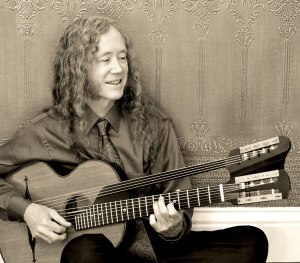
John Schneiderman is one of the great modern virtuosi, combining a formidable technique with very refined feeling. As one critic put it: “Obviously what we are dealing with here is extreme virtuosity.”
I first came across John as a lute player, then became envious of his Herman Hauser I 10-string guitar (check out his YouTube videos with that instrument), and finally discovered his sterling work as a Russian guitar soloist or duo partner with Oleg Timofeyev. I’d also like to put a plug in for his duo album of Beethoven arranged for two guitars – stunning!
Here is an interview I conducted with John in March, 2024:
===
Interview with John Schneiderman
Rob MacKillop: Hello John, and welcome to SarenkoAndCo.
I want to say at the outset that I have long been a fan of your lute and guitar playing. Among my all-time favourite albums is the ‘Beethoven for Two Guitars’ you recorded with Hideki Yamaya, on two beautiful 19th-century 6-string guitars. Highly recommended.
John Schneiderman: Thanks for the kind words, Rob. The Beethoven recording was an interesting project. After we located a number of very well-crafted 19th-century arrangements, we were surprised to discover that these works had not been recorded. It seemed like such an obvious project with a great composer.
RM: But regarding Russian 7-string guitar music, it is the 7-disc box set you recorded with Oleg Timofeyev which jumps to mind:
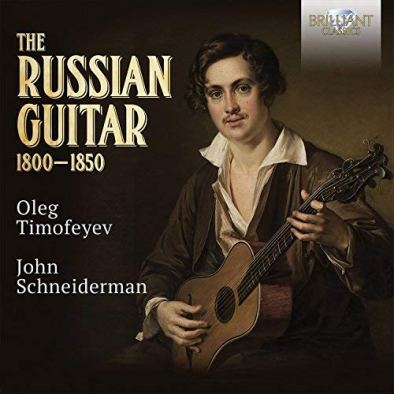
What an incredible collection! It commences with Oleg playing two solos by Sychra, followed by three more played by yourself. I was immediately struck by how different you sound from each other. Both incredible, of course, but the difference is very marked. Oleg plays with nails, and has a technique that is built for projection to a large room. The guitar sounds big and at times piano-like. By contrast, your no-nail technique sounds very intimate, as if you were playing just for me. It sounds more personal, for player and listener. Now, I’m not saying one is better than the other, and what is wonderful is that the music sounds ‘just right’ either way. And, given all that, it is remarkable that when the pair of you play duets, the techniques sound the perfect complement to one another.
JS: I’m glad you feel that way! For someone who uses a “no-nail” technique, I actually produce quite a bit of volume. Listeners and even other players are often astonished to discover I play without nails.
RM: So, finally, a question: Could you please talk about your right-hand technique, and your approach to sound aesthetics?
JS: When I first studied classical guitar, I played with nails. Very early on I also became interested in the lute; at first the renaissance lute, and then the baroque lute. Once I became more serious about the lute, I cut my nails. I enjoy the feel of the strings on my fingertips and prefer the sound of strings against flesh over the harsher sound of playing with fingernails. I can create a wider variety of tone and articulation without nails and feel that this adds interesting detail to the performance. I often, but not always, rest my right-hand little finger on the top. I play at about a forty-five degree angle to the string rather than more perpendicular. I tend to favor p,i,m and only use ‘a’ when absolutely necessary. I am always aware of the string crossing. I bring the right-hand thumb up to the treble strings for certain types of passages. I do not strictly alternate, but often repeat fingers. All of this helps with speed, agility, and articulation. I try to gravitate towards fingerings that make the passages as easy as possible.
RM: Well, I could have written that entire paragraph myself! It seems we both have very similar experiences regarding technique. I’m wondering if you ever play the Russian guitar with gut trebles?
JS: I have experimented with gut trebles on the Spanish guitar and the Russian guitar; however I generally play on rectified nylon trebles.
RM: Rectified strings, for those who have not personally experienced them, have a slightly rough texture which helps flesh players get more of a grip of the string. Grip is too strong a word, more of an improved contact. I find it is a more tactile technique, which helps me feel I am creating the sound.
Watching your video performances, I see you use the technique of left-hand thumb on the fretboard, as indicated in many scores. Not many players utilise this technique today – perhaps I am wrong, but that’s the impression I’m getting – and I wonder if it is comfortable for you?
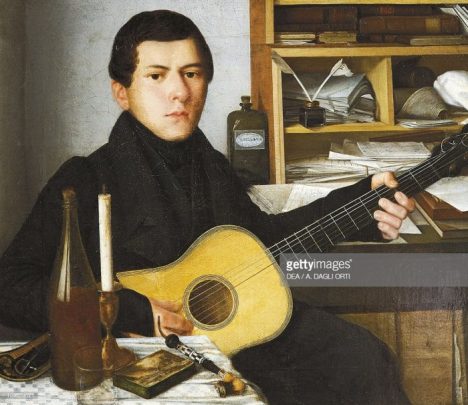
JS: Yes, I am very comfortable fretting with my left-hand thumb. I played folk music on the guitar before my classical guitar studies and frequently fretted with the left-hand thumb. I learned to play an F chord with my thumb fretting the low 6th-string F before I learned how to play a bar chord. If I wanted to add a low F# to a D chord, I played the low F# with my thumb, and left the fingering of the D chord intact. I continued with this technique in my classical guitar studies. Other classical players and teachers often frowned on this technique, but once I discovered that Giuliani and Mertz indicated fretting with the left-hand thumb, all bets were off and I felt free to use my left-hand thumb if and when it facilitated a passage. Once I started playing the Russian guitar, I was thrilled to discover that this is a frequently used technique. On both the Spanish and Russian guitars there are chord voicings that are not possible without fretting with the thumb. On a six-course lute I am often tempted and use my left-hand thumb for fretting the sixth-course.
RM: I have a large hand and long fingers, and have often used the thumb on the 6th string of a standard modern classical guitar, though it is more difficult in higher positions. Playing 19th-century guitars with either 6 or 7 strings, the technique becomes easier, and both Giuliani and Sychra were evidently at home with the technique. Do the fingerboards of your 7-string guitars have the camber (curved fretboard) to help with the technique?
JS: At present I have six Russian guitars. The instruments with single necks, seven strings and no additional basses, have extremely curved fingerboards which make fretting with the thumb more comfortable. I regularly fret the seventh and sixth strings with my thumb, and occasionally even the fifth string. I discovered a piece by von Held where he indicates the thumb fretting the fifth string. The Russian guitars I have with double necks and additional basses tend to have much flatter fingerboards which makes fretting with the thumb a bit less comfortable. The additional basses include notes that would typically be fretted with the thumb on the seventh and sixth strings. I love the sound of these larger double-neck guitars with additional basses, however, because I enjoy fretting with my thumb, I rarely use the additional basses. Instead, I often mute them so that they are not adding unwanted and unnecessary additional resonance which can be annoying, especially when recording.
RM: You have a number of videos of Russian guitar music, and in some you are playing a quart guitar. Can you explain what that is, and this might also be a good place to mention your collection of Russian guitars?
JS: The smaller Russian guitars that I often play are actually quart guitars that are tuned a fourth higher than the standard Russian guitar. The standard Russian guitar is tuned to a G chord and the quart guitar is tuned to a C chord. Like the terz guitar in the Western European tradition, the notation is written as if it is in standard tuning, but the instrument actually sounds at a higher pitch.
There are some Russian guitar duets for equal guitars, but the majority seem to be for Russian guitar and Russian quart guitar which gives the duet incredible range and makes arrangements of practically anything possible. The smaller quart guitars often project incredibly well which is one of the reasons I can be heard above a larger guitar being played with nails. My Russian guitars:
- A. Marchal, Mirecourt, Circa 1820: 7-String with Russian Neck (a mid-19th century conversion). 61cm String Length
- Ivan Krasnachekov, Moscow 1867: 7-String Russian Quart Guitar, 56cm String Length
- Ivan Krasnachekov, Moscow, 1858: 7-String Russian Quart Guitar, 52.5cm String Length
- Mikhail Vasillievich Yeroshkin, Riazan’ 1908: 11-String (7+4) Russian Guitar, 64cm String Length
- Jan Tulacek, Dobříš, Czech Republic 2019: 11-String (7+4) Russian Guitar after Johann Gottfried Scherzer, 64cm String Length, Luthier’s website.
- Jan Tulacek, Dobříš, Czech Republic 2021: 11-String (7+4) Russian Quart Guitar. Scaled Down Version after Johann Gottfried Scherzer, 56cm String Length
When I first started playing 19th-century guitars (Spanish & Russian) the only instruments available were old ones. Now there are a number of talented builders who make copies, so I gravitate to the newer instruments as they tend to have fewer issues and are not necessarily as valuable as the older instruments. I also enjoy supporting our current builders. I have two beautiful newer guitars by Jan Tulacek which I play exclusively.
RM: Looking over your entire discography – which is extensive – you do seem to enjoy ensemble playing. Could you talk a little about that in general, and also specifically with the Russian guitar in mind?
JS: I am always looking for repertoire that has not been previously recorded. My first ensemble recordings were on the baroque lute: Haydn, Kohaut, Baron, Kropfgans, Falckenhagen, & Hagen. Working with experienced bowed string players taught me a lot. Many of the baroque lute parts in the music for lute and strings are quite spectacular and I even pass them off as solos sometimes. I have always enjoyed guitar duets. With two guitars, either Spanish or Russian, one can play practically anything; symphonies, operas, the sky is the limit. When I first met Oleg Timofeyev he was looking for a duo partner to explore the wonderful repertoire for two guitars, much of it for Russian guitar and Russian quart guitar. Within a week he sent me a beautiful instrument and a pile of music. On both the Spanish guitar and the Russian guitar I have always been simultaneously exploring the solo repertoire and duet repertoire.
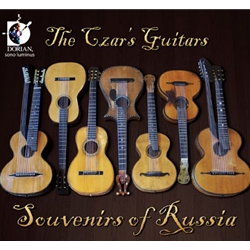
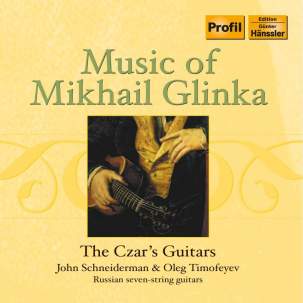
RM: Other album’s I would like to mention are the two by The Czar’s Guitars, the duo you formed with Oleg. I have ‘Souvenir’s of Russia’ and also ‘Music of Mikhail Glinka’.
JS: There is another more recent recording that I must get to you: “A Tribute to Vladimir Morkov” which was released in 2020. The 2-CD set includes solos and duos including the most virtuosic set of variations I have worked on for either Spanish or Russian guitar: Variations on Carnival of Venice.
RM: Are there any more projected for the future?
JS: Yes, we are currently working on a recording dedicated to the music of Mikhail Vysotsky. This recording is exclusively solos, primarily theme and variations on Russian songs. I have already completed eight tracks (45 minutes) and Oleg is in the process of recording his solos for the CD. In addition to that we are regularly rehearsing (via Skype) duos from two sets of manuscript part books from 1856 and 1858. The duos include Italian and Russian opera potpourris, Russian songs, Mozart and Schubert arrangements, and other gems. For this recording Oleg and I will have to be in the same place at the same time.
RM: I particularly enjoyed hearing Fernando Sor’s ‘Souvenir de Russie’ (Op.63) in the context of the genuine article.
JS: For that recording I played on a six-string Spanish guitar and Oleg played on a seven-string Russian guitar. I had played the piece for a number of years and did not see the need to re-learn it in the Russian tuning. An interesting problem occurred during the recording of that piece; there is a variation which is played completely in harmonics which do not speak as well when one plays without nails. We attempted the variation a couple of times, and the engineer kept insisting that Oleg needed to be quieter, and I needed to be louder. Well, I reached into my pocket, pulled out a pick, and played the harmonic variation with the pick. Suddenly the harmonics were crystal clear!
RM: LOL! That is very funny. I think we’ll end it there…
Here are some of John Schneiderman’s Russian Guitar Videos and Recordings:
Videos
Thankfully, John is generous with his videos – many more on youtube: JohnSchneiderman YouTube Channel
Recordings
 Sarenko And Co